
Most CLAT aspirants believe that taking more mock tests automatically leads to better scores.
But here’s the reality:
Many students attempt 30–40 mocks and see little improvement. Meanwhile, toppers often take fewer tests but consistently improve their scores.
The difference isn’t in the number of mocks attempted—it’s in the quality of CLAT Mock Test Analysis.
A mock test is not just a scorecard. It’s a detailed report showing exactly where you’re losing marks, wasting time, and making avoidable mistakes.
If you’re serious about securing a top rank in CLAT 2026, mastering mock analysis is just as important as taking the mock itself.
Let’s explore the 5-step method toppers use to transform every mock into a score-boosting opportunity.
Why CLAT Mock Test Analysis Matters
Think of a mock test as a diagnostic tool.
It helps you identify:
Weak subjects
Time management issues
Accuracy problems
Reading speed limitations
Question selection mistakes
Without proper analysis, every mock becomes just another number.
With proper analysis, every mock becomes a lesson.
Many CLAT toppers spend almost as much time analyzing a mock as they spend writing it.
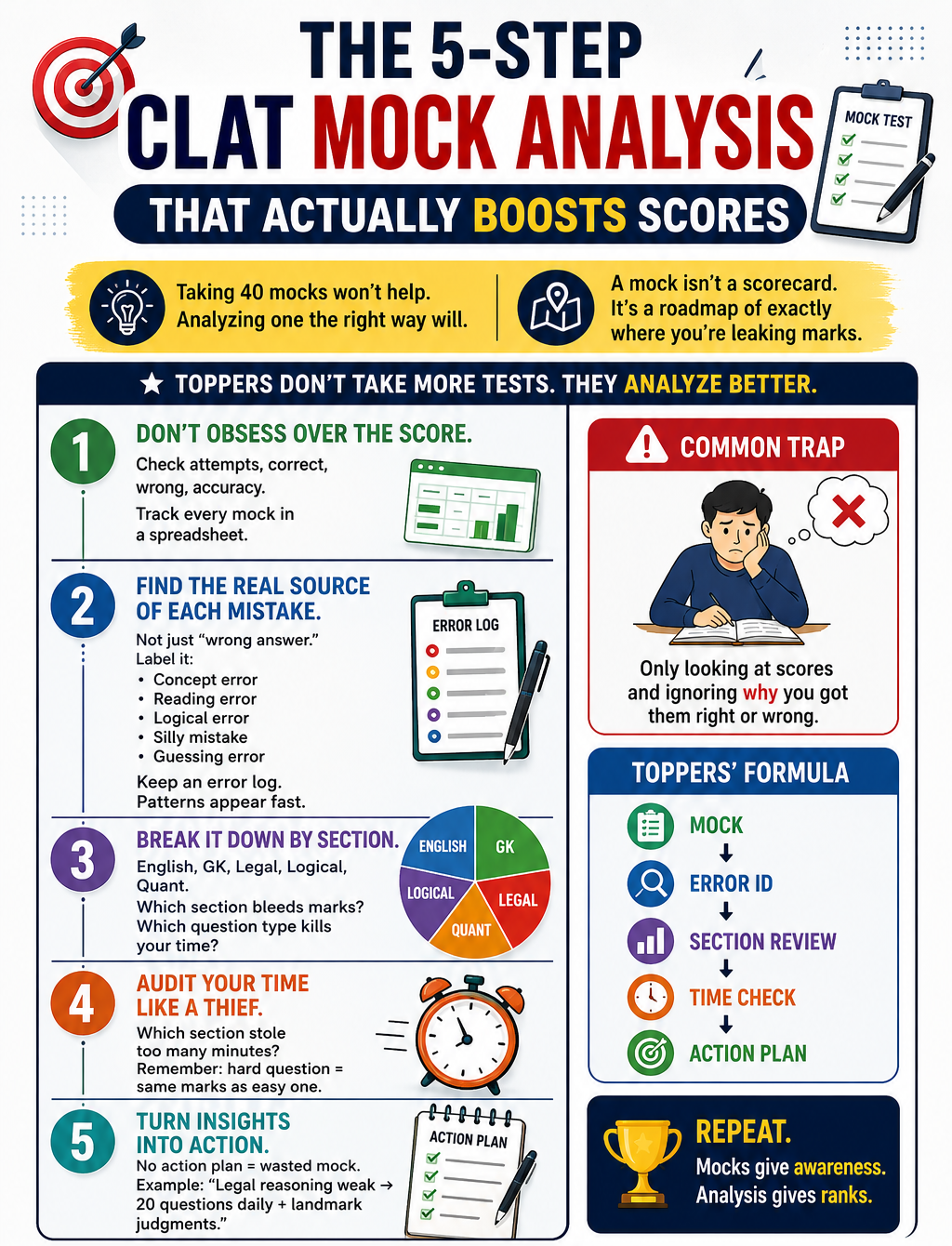
Step 1: Analyze Your Overall Performance
The first thing toppers do is avoid obsessing over the final score.
Instead, they ask:
What Does This Score Mean?
Look at:
Total score
Attempted questions
Correct answers
Incorrect answers
Accuracy percentage
For example:
| Metric | Result |
|---|---|
| Attempted | 95 |
| Correct | 80 |
| Wrong | 15 |
| Accuracy | 84% |
This gives a clearer picture than simply saying, “I scored 76.”
Questions to Ask
Did I improve compared to the previous mock?
Was accuracy better or worse?
Did I attempt too many questions?
Did I leave easy questions unattempted?
Track these numbers in a spreadsheet after every mock.
Patterns become visible very quickly.
Step 2: Identify the Source of Lost Marks
Most students only check which questions were wrong.
Toppers go deeper.
Every incorrect answer falls into one of these categories:
Concept Error
You didn’t know the concept.
Example:
Weak understanding of Constitutional Law
Lack of Current Affairs knowledge
Reading Error
You misunderstood the passage.
Example:
Missed a keyword
Misread a sentence
Logical Error
You understood the passage but selected the wrong conclusion.
Silly Mistake
You knew the answer but clicked the wrong option.
Guessing Error
You attempted a question without sufficient confidence.
Create an error log like this:
| Question | Section | Error Type |
|---|---|---|
| Q12 | English | Reading Error |
| Q34 | GK | Concept Error |
| Q61 | Legal | Logical Error |
After 5–10 mocks, you’ll know exactly where your score is leaking.
Step 3: Conduct Section-Wise Analysis
The next step is breaking performance down by subject.
English Language
Check:
Reading speed
Vocabulary questions
Inference-based questions
Ask yourself:
Which passages took the longest?
Which question types caused errors?
Current Affairs & GK
Identify:
Static GK gaps
Monthly current affairs weaknesses
Track recurring themes:
International relations
Economy
Sports
Science and Technology
Legal Reasoning
This section often determines ranks.
Analyze:
Principle application questions
Legal passage comprehension
Logical interpretation
Many students lose marks not because they lack legal knowledge, but because they rush through passages.
Logical Reasoning
Track:
Assumption questions
Conclusion questions
Argument-based questions
Look for recurring mistakes in reasoning patterns.
Quantitative Techniques
Identify:
Calculation errors
Data interpretation mistakes
Time-consuming question types
Section-wise analysis helps prioritize future study sessions.
Step 4: Evaluate Time Management
One of the biggest reasons students underperform in CLAT is poor time allocation.
Toppers carefully analyze where every minute went.
Record Section Timings
For example:
| Section | Time Taken |
|---|---|
| English | 25 min |
| GK | 12 min |
| Legal | 38 min |
| Logical | 25 min |
| Quant | 20 min |
Now ask:
Which section consumed too much time?
Which section should have been completed faster?
Did difficult questions slow me down?
The Toppers’ Rule
Never spend excessive time on one question.
Remember:
A difficult question and an easy question carry the same marks.
Smart question selection often improves scores faster than additional studying.
Step 5: Create an Improvement Action Plan
This is where most students fail.
They analyze the mock.
They understand their mistakes.
Then they move on.
Toppers don’t.
Every mock ends with an action plan.
Example Action Plan
English
Read editorials daily
Solve 2 comprehension passages per day
Current Affairs
Revise monthly current affairs notes
Focus on international organizations
Legal Reasoning
Solve 20 legal reasoning questions daily
Review landmark judgments
Logical Reasoning
Practice assumption and conclusion questions
Quantitative Techniques
Improve percentage and ratio concepts
Solve one DI set daily
The goal is simple:
Every mock should directly influence your next week’s preparation.
Common Mistakes Students Make During Mock Analysis
Avoid these common traps:
Only Looking at Scores
The score is a result, not the lesson.
Ignoring Correct Answers
Analyze correct answers too.
Sometimes a correct answer was simply a lucky guess.
Not Maintaining an Error Log
Without an error log, patterns remain invisible.
Taking Too Many Mocks
Quality analysis beats quantity.
Ten well-analyzed mocks are often more valuable than thirty poorly analyzed ones.
Skipping Review Sessions
The biggest improvement happens after the test, not during it.
The Mock Analysis Formula Used by Toppers
After every mock, follow this formula:
Mock Attempt → Error Identification → Section Analysis → Time Review → Action Plan
Repeat this cycle consistently.
Each mock should make you slightly better than the previous one.
That’s exactly how toppers gradually move from scores of 60–70 to 90+.
Final Thoughts
A mock test is not a judgment of your ability.
It’s feedback.
The students who treat mocks as learning tools improve rapidly. The students who focus only on scores often remain stuck.
If you want to maximize your CLAT 2026 preparation, remember this:
Taking mocks improves awareness. Analyzing mocks improves ranks.
Use this 5-step CLAT Mock Test Analysis method after every test, and you’ll start identifying weaknesses, correcting mistakes, and steadily boosting your score.
The next time you finish a mock, don’t rush to the score.
Spend time understanding why you got that score.
That’s the habit that separates average aspirants from future NLU students. 🚀